By Chrys Gringo · Magic Nylon's steel-string sibling
You play for about twenty seconds. It learnsyour guitar.
Steel-string guitar at home almost always ends up as a line straight from the piezo, because putting up a mic takes time and a quiet room you don't have. And the piezo hands you that thin, nasal, plastic sound. So on the BODY page you press MY GUITAR: you play for about twenty seconds, it learns how YOUR guitar sounds on the line, marks the captured voice closest to your sound with a star, and FIT tailors that voice to your instrument. Put that together with NOISE, which learns your room's noise in ~2 seconds, and with the MAGICOM reverb: that is Magic Bronze, your guitar sounding like a studio, now.
Proof first
Every pickup sounds different. The plugin learns yours.
The mistake I see a lot of people make is running down the body list, trying one at a time, by ear, until they give up and settle for the first one. Here the path is different: you play, it measures, and the choice comes ready.
PLAY · ~20 SECONDS
It takes a snapshot of your pickup.
You open the BODY page, press MY GUITAR and play the way you play: strumming, fingerpicking, whatever you usually record. In about twenty seconds the plugin builds a profile of how your guitar and your pickup sound together. Use whatever guitar you have there: the profile belongs to YOUR instrument.
BODY page → MY GUITAR button.
★ · THE SUGGESTION
The star marks the voice closest to your guitar.
With the profile ready, it compares your sound with every captured voice and marks the closest one with a star. One click and you are on the body closest to your instrument, so you don't start from a guess.
The ★ shows up right in the voice selector.
FIT · THE TAILORING
The voice molds itself to your guitar.
Turn FIT on and the chosen voice adjusts to your pickup's profile: a gentle, bounded correction, computed from your own profile, with honest volume. In our measurements it closes about a third of the timbre difference between different guitars. The rest is your instrument's character, and it stays.
FIT pill next to the voice selector.
Until now, if you wanted a device listening to your own guitar, you bought dedicated hardware in the 300 to 450 dollar range, a ToneDexter, a Fishman Aura, and trained it with your own instrument. Here that job lives on one page of the plugin that already handles the rest of your chain. And the profile is saved with the session: changed strings or setup, press MY GUITAR again, play about twenty seconds and move on.
The finished guitar costs $19.99 at launch. With its nylon sibling, $29.Buy once, it's yours forever. No subscription, no monthly fee.see everything in the suite
Steel-string guitar sounds, organized by real styles.
Banks by style: Sertanejo, Worship, Pop/Ballad, Folk, Country, Acoustic Rock, MPB, Voice & Guitar, Fingerstyle and Stage, plus Essentials and the captured voices in the Guitars bank. The style presets carry the fine-tuning an engineer would dial, from the compressor to the delay figure. Inside each bank the DI sounds come first and the mic ones after, so you cycle fast with the arrow keys, browser closed. Try it. In stereo mode a dedicated bank comes in, recalibrated preset by preset for the mic and line pair.
Interactive mockup. Filters, search, favorites and recent all work with the same logic that ships in the plugin.
The voice library
We captured every voice here ourselves. One per body style, at the same perceived loudness.
Body libraries are easy to inflate: dozens of files pulled from around the internet, each with a room baked in and a different volume, so you switch bodies and what changes is the gain. We went the other way: we captured every voice with our own measurement process, one guitar chosen per body style, only the body of the instrument, because the space lives in MAGICOM. And we level-matched everything by perceived loudness, so switching voices changes the guitar, never the volume, and your ear compares timbre on equal footing. There are three voices today, with the next ones already showing in the selector, and the MY GUITAR star marks the one closest to your guitar.
BABY DR · DEFAULT
The compact dreadnought that opens the house.
Captured from a Taylor Big Baby BBTe: dread shape in a leaner body, firm lows, present mids, the sound of the working folk guitar. It is the default voice: open the plugin and it is already waiting for you.
In the selector: BABY DR
MOD AUD
The modern auditorium.
Captured from an Ibanez AAM70CE, an auditorium of contemporary build: balanced mids, separated notes, a body that sits in the mix close to the voice. The pick for pop, for worship, and for anyone singing over their own guitar.
In the selector: MOD AUD
DREAD
The American studio dreadnought.
Captured from a Martin DCX1E through an AKG C414 into an API preamp, a classic studio chain for steel-string guitar. Big body, deep lows, the band bed of folk, country, and roots sertanejo.
In the selector: DREAD
The next voices
GRAND AUD, JUMBO and PARLOR already show in the selector, dimmed, waiting for the right guitar to pass through the studio. The library grows with every captured guitar.
The previous library was retired: it did not pass our new capture standard, so we went with few voices, all verified, instead of a long list. Your old sessions and presets automatically land on the new voice of the same guitar family, so none of your projects opens silent.
The voices apply in DI mode; in Mic mode, BODY becomes a warm low shelf. And the Your IRs bank stays open: drop a WAV in the folder and it shows up on the BODY page, leveled to the same perceived loudness as the factory voices.
Taylor, Big Baby, Ibanez, Martin, AKG, API, ToneDexter and Fishman Aura are trademarks of their respective owners, mentioned here only to identify the instruments and equipment captured or compared. No affiliation or endorsement is implied.
The big-record trick
The mic hears the wood. The line hears the steel. Your guitar is both.
When you record a steel-string with mic and line together, the usual move is picking one in the mix and muting the other. Each one hears half the instrument though: the mic brings the wood and the air of the room, the line brings the shine of the bronze and the pick attack. On the acoustic records that sound huge, both are playing, one on each side of the image. ST mode does that right here: mic on the left, line on the right, each side with the treatment it asks for, and the pair becomes one guitar, big the way you hear it on records.
Real interface capture in ST mode, no mockup: mic on the left channel, line on the right, both lit.
What the mode gives you
SET · 4 SECONDS
You play for four seconds and the plugin matches the line to the mic, time-aligns the pair and fixes polarity. The image sits centered and stays mono-safe. Dialing that by hand usually eats a studio afternoon.
PER-SOURCE MIXER
Pan, level and solo for each side on the BODY page. You solo the mic, solo the line, hear what each one brings and balance it by ear, not by guessing.
TWO MICS
Got two microphones? Click the R pill and the pair becomes a true-stereo mic rig, with mic voicing on both sides. One mic and one line work too, use whatever you have around.
STEREO BANK
A whole bank calibrated for this mode, style by style. The browser shows the right bank for the mode you are in.
ST mode asks for an interface with two inputs, the same one you already use when you record mic and line. We went looking for another guitar plugin that does this complete pair, with per-side voicing and automatic setup, and we did not find one.
Try it yourself
Now try it yourself.
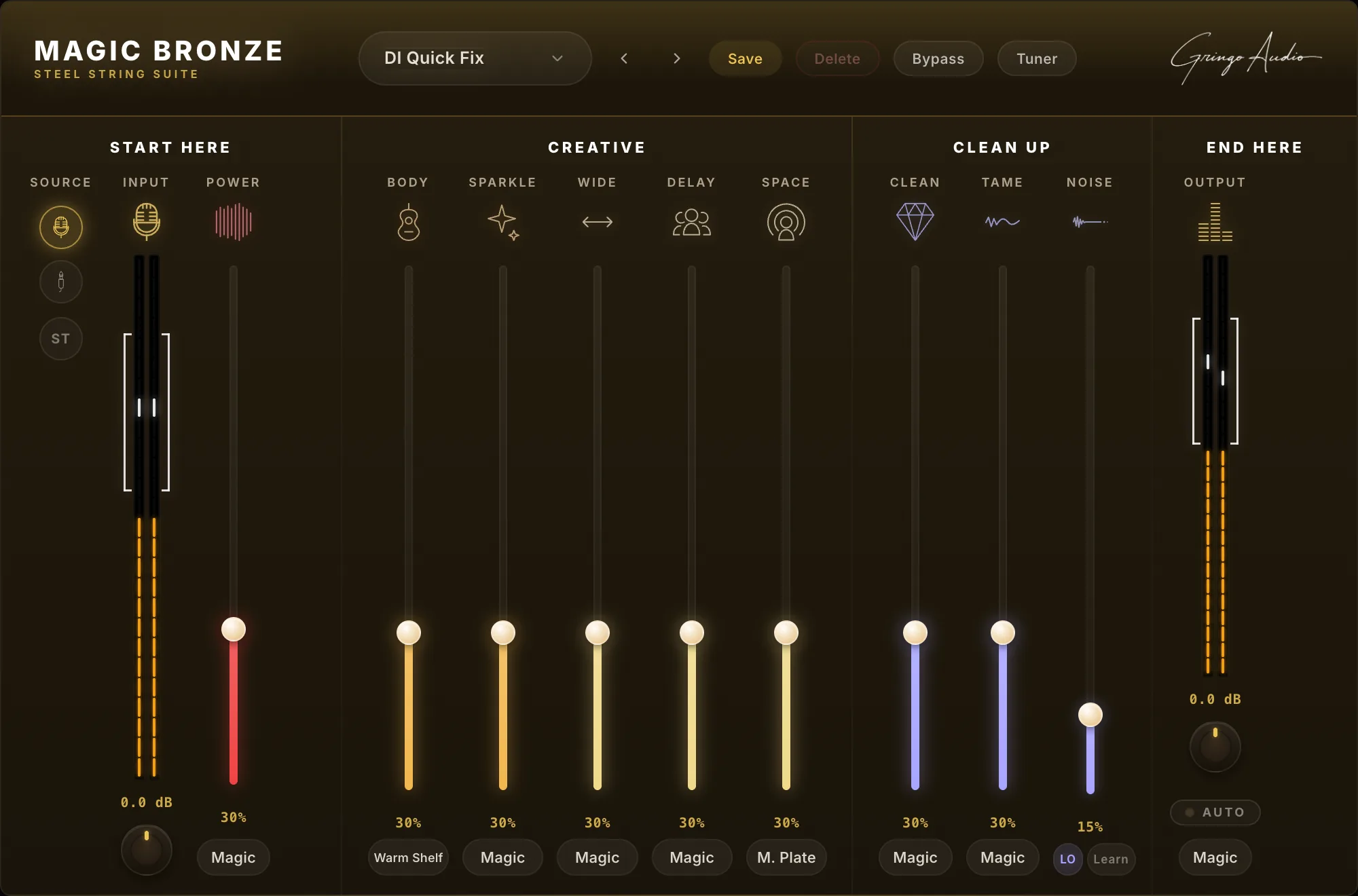
This is a mockup of the plugin: try the buttons, roll the body and space selectors, run LEARN. Icons are per-effect bypasses; faders light up as you push each effect. Mixing becomes a sonic, tactile process, simple and fun.
Magic BronzeSteel String Suite
Start Here
Source
Input
OPTIMAL
INPUT
0.0 dB
Power
45%
Magic
Creative
Body
45%
BABY DR
Sparkle
50%
Magic
Wide
0%
Magic
Delay
0%
Magic
Space
20%
M. Plate
Clean Up
Clean
55%
Magic
Tame
35%
Magic
Noise
20%
LO
Learn
End Here
Output
OPTIMAL
OUTPUT
0.0 dB
Magic
Full control, on the rare day you need it
One click for the preset. One more for everything else.
Presets cover ~90% of the cases. The other 10%: learning YOUR room's noise, bypassing one effect, letting AUTO match the volume. All one click away, in the same plugin.
LEARN · NOISE
It learns your room's noise in 2 seconds.
Click LEARN and stay silent for ~2 seconds: the plugin captures your room's noise fingerprint (fan, AC, cable hum) and cleans deeper with fewer side effects. One fader handles the rest.
Clean Up zone → LEARN pill under the Noise fader.
BYPASS PER FX AND PER ZONE
Click an icon and kill that effect.
Every effect icon is a bypass button. Zone titles too: tap CREATIVE and the whole group goes silent at once. Useful to hear exactly what each piece does without undoing the preset.
Icons and zone labels are bypass switches.
AUTO GAIN
Honest volume: what changes is the tone.
The AUTO pill matches the processed level to the raw signal. If a fader move sounds better, it is actually better, not just louder. The kind of honesty plugins almost never have.
End Here zone → AUTO pill under Output.
MY GUITAR · PROFILE
Changed strings, redo it in twenty seconds.
Your guitar's profile is saved with the session, so it comes back when you reopen the project. New strings, new setup, another guitar in the same project: press MY GUITAR again, play about twenty seconds and the star updates to the guitar in your hands right now.
BODY page → MY GUITAR → Redo profile.
What each fader does
Nine faders and a tuner. Calibrated for steel strings.
Each macro does one specific, musical job, tuned by Chrys for steel strings, bronze-string shimmer, pick attack and piezo quack ask for a different calibration. No endless menu: decisions you can hear.
POWER
Studio-grade steadiness.
A parallel compressor: it evens out the dynamics on a copy of your signal and blends it under your dry guitar. Your strumming stays yours, phrases stop sinking in the mix, and sustain shows up.
BODY
Wood, not a cardboard box.
In DI, it blends your line signal with a captured real steel-string studio body, the plastic sound becomes wood. In Mic, it becomes a warm low shelf that gives a thin recording its chest back.
SPARKLE
Fresh-strings brightness.
Lifts the zing of bronze strings and the air of the attack without turning brightness into pain. Strings changed yesterday, in the right dose.
WIDE
A guitar that hugs.
Doubles your take with a 7-voice symmetric doubler and stretches the image with a mono-safe imager. The second page picks the voices: 1, 3, 5 or 7. Push it in the chorus for a wall of guitar; pull it back for the intimate verse.
DELAY
Space between the notes.
A short, musical delay tuned to sit behind the guitar. A subtle throw at the end of phrases, never rhythmic clutter.
SPACE
The MAGICOM on one fader.
Authorial convolution reverb spaces in the selector, amount on the fader. From dry studio to cathedral, without opening another plugin. The full story right below.
CLEAN
Un-muds the middle. And the quack.
Clears the low-mid buildup that makes home recordings murky and holds back the piezo's nasal quack. The guitar steps forward without getting thin.
TAME
Tames the harshness.
Holds back harsh pick peaks and steel-string squeak. Works with SPARKLE: all the brightness you want, none of the sawtooth.
NOISE
Noise, solved on one fader.
Gate and spectral reduction together. LO (~8 ms) to play and record while monitoring; HQ for maximum cleanup at mix time. With the LEARN button, it reads your room's noise in 2 seconds and cleans using your room's own fingerprint.
TUNER
A full-page tuner.
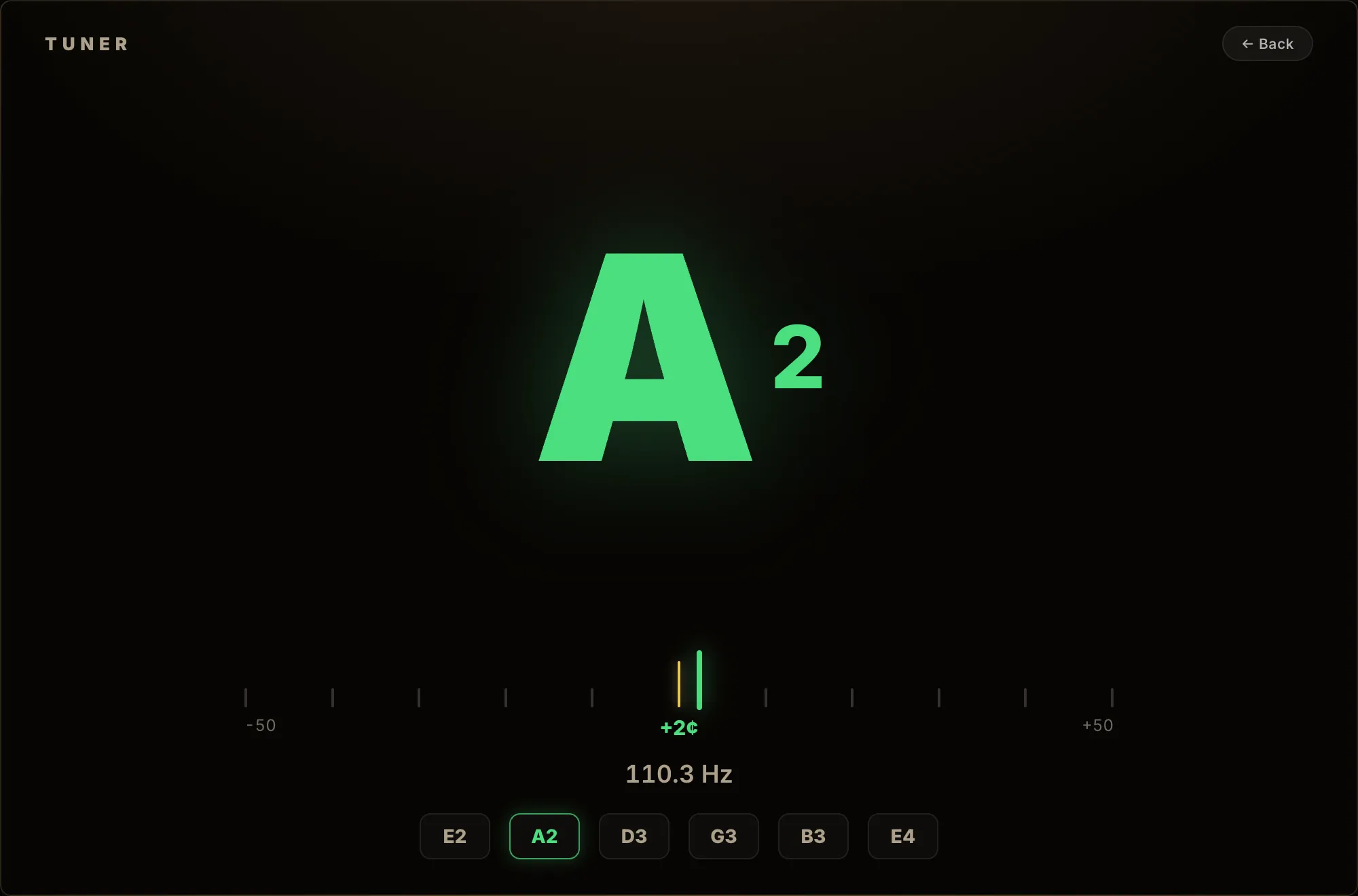
One click in the header and the tuner takes the screen: big, precise, reading the raw signal before any effect. Tune, close, record.
The reverb engine
Ordinary reverb imitates a room. Ours photographs it.
Almost every plugin reverb is an algorithm guessing how a room might sound. Convolution works from different raw material: an acoustic photograph of a real space. Your guitar starts sounding inside that space, with the exact character of the original. It is the most faithful reverb technology there is.
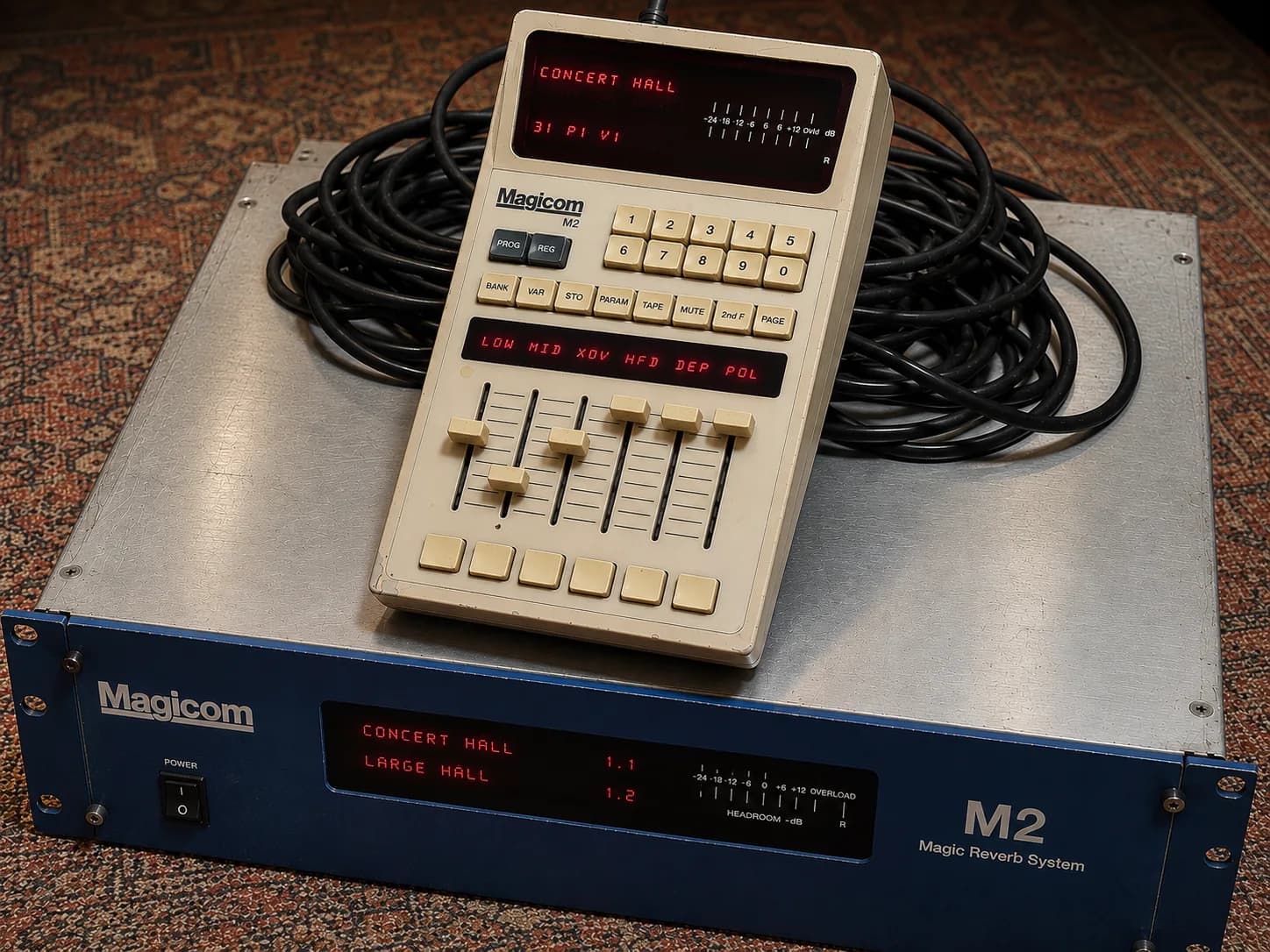
MAGICOM is our convolution engine, and its library is authorial: we captured every space in true stereo and kept, by ear, only what sits right on an acoustic guitar. There are families of spaces, each with a job: the dry wooden room for bossa, the frontal plate for percussive playing, the hall that holds your guitar in place with air around it, the vintage concrete chamber you hear on soul records, the dense steel plate for ballads. Generic bundle spaces do not get in. And each space carries its measured reverb time written into its name.
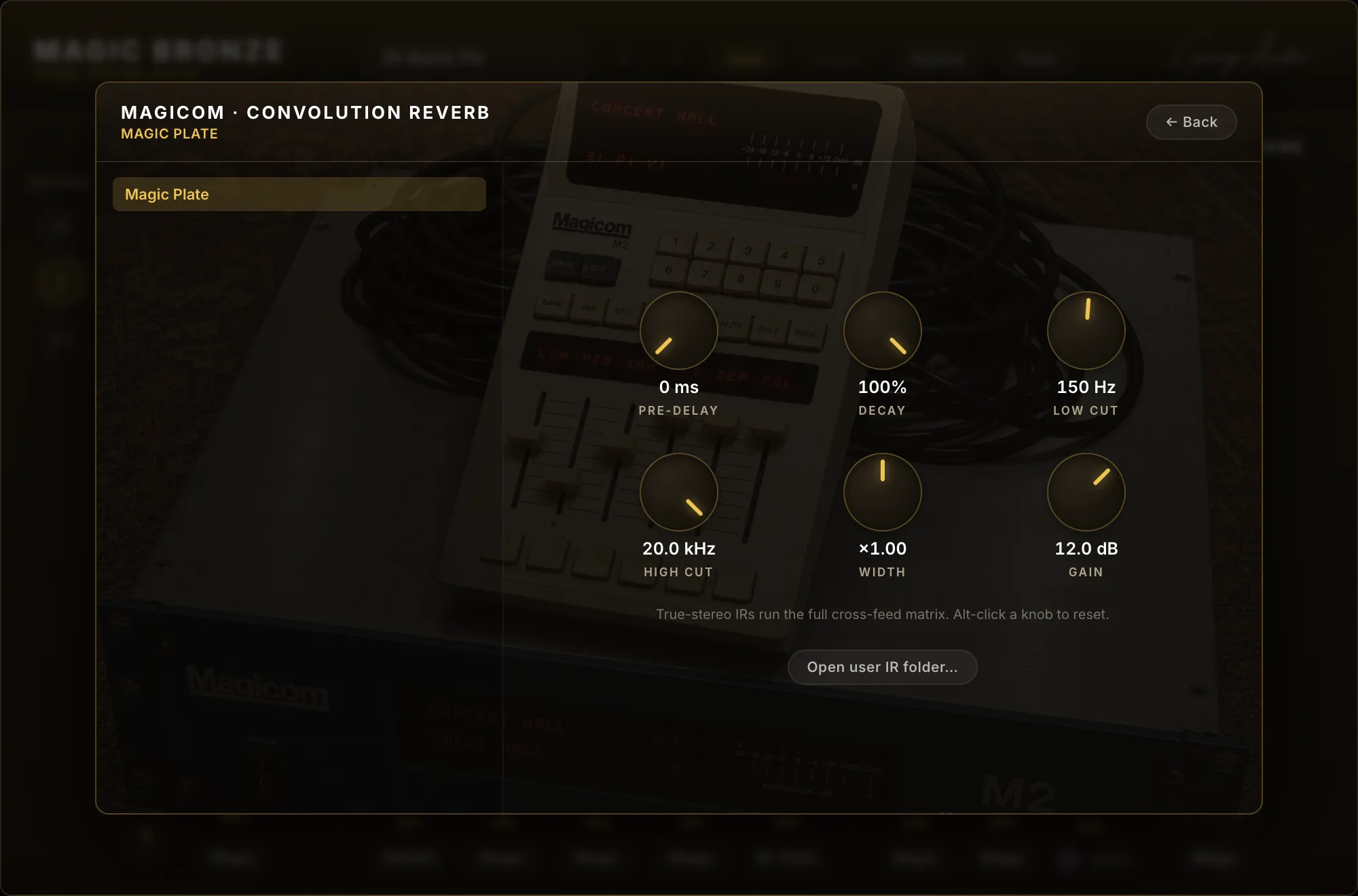
Click the reverb's name inside the plugin and the full editor opens: pre-delay, decay, filters, width and gain. And if you have your own IRs, load them right there. Every factory preset already comes with the space chosen for its style, you just decide how much.
The real MAGICOM editor, opened over the plugin with one click on the reverb name. The full engine ships in both plugins of the family; in Magic Bronze, the SPACE fader is it.
For the day you want to go deep
A fader up front. A lesson underneath it.
Every fader hides a second page: click the style window under it and the full technical control appears. On the dynamics pages YOUR signal draws the graph in real time; on the delay, a rhythmic timeline; on the body, captures that keep your attack. You learn by mixing, on the groove you are recording right now.
The compressor page, with your live signal and the threshold dragged right on the graph.
PAGES THAT TEACH
The compressor shows you where you stand.
The POWER page draws your level live and you drag the THRESHOLD right on the display, the way classic studio compressors work. A gain-reduction meter with the sweet zone marked, a tooltip on every knob, and a GUIDE ME that walks you through it, validating each step with your audio.
Every module has one: delay with a rhythmic timeline, body with captures, master with a draggable ceiling.
READY-MADE STYLES
Magic is the house ideal. Custom is you.
The style window under each fader cycles fixed styles: Gentle, Magic and Tight on the compressor, figures on the delay, strengths on tame. Magic is the setting Chrys calibrated for steel strings; the moment you fine-tune the second page, it becomes Custom. One click on the window opens the lesson.
The window arrows switch styles without opening anything.
TOUR AND KEYBOARD
Sixty seconds and you know the house.
On first open, a guided tour walks the zones in the right order, from noise to honest volume. After that, pick in hand: the arrow keys change presets from anywhere in the plugin, B toggles bypass, A toggles AUTO. Built for players who track alone.
To replay the tour, click the Gringo Audio logo and choose Run the tour again.
The noise floor
Your room makes noise. Your recording won't.
Every home studio has a noise floor: the fan, the AC, the pickup hum, the street outside the window. The microphone and the DI line pick up all of it along with the guitar. The Clean Up zone attacks that floor on two fronts, spectral reduction to pull the noise out from inside the sound and a gate to hold the silence between phrases. And that setting belongs to the room, not the song: once you calibrate NOISE, no preset ever touches it.
The same take, before and after spectral reduction: on the left, the harmonics buried in the dust; on the right, only the strings.
The three moves
LEARN
Memorizes the noise print of YOUR room in 2 seconds of silence.
SPECTRAL
The reduction pulls noise out from inside the sound, frequency by frequency, and the notes stay.
GATE
Between one phrase and the next, it holds absolute silence. No hiss creeping up when you stop playing.
Built for constant noise: fan, street, AC, the neighbor through the wall. That covers about 90% of home recording cases.
The tuner
You tune where you record, on the signal that goes in.
One click on TUNER in the header and the tuner takes over the page: giant note, cent readout, frequency in Hz. It listens to the raw signal before any effect, so what you tune is exactly what the recording receives. Tune, go back to the faders, record.
The Creator
Built by Chrys Gringo. First nylon. Now steel completes the pair.
Music producer, educator, plugin developer and Full Sail University ambassador, a reference for 290k+ creators learning to make better music from home studios, not million-dollar rooms.
290k+
YouTube subscribers
20 years
teaching audio
Full Sail
Ambassador
“
When I launched Magic Nylon, one question kept coming back: what about my steel-string? Everyone recording at home owns a steel acoustic with a piezo, and the line sound stays thin, nasal, with no wood in it.
Magic Bronze is the same philosophy with a different calibration: captured bodies of steel-string studio guitars, presets from worship to country, and the MAGICOM on reverb. Hit play and the guitar comes out finished.
— Chrys Gringo
After years helping creators rescue thin, muddy or noise-drowned guitar recordings, the process stays simple:
1Choose Mic or DI.
2Pick a style.
3Shape the sound by ear.
No EQ curves. No endless tutorial hole. No subscription trap. A complete guitar chain you buy once for a fair price, own forever, and reach for every time your guitar needs to sound finished.
Final step
Stop fighting your guitar. Start releasing.
VST3 / AU / AAX. Installs alongside your DAW in under a minute. Buy once, own forever.
Mac & Windows · VST3 · AU · AAX · Works with Pro Tools, Logic, Ableton, FL Studio, Cubase, Reaper, Studio One.
Questions
Everything you're about to ask.
Is that the real plugin up there or just a mockup?
The interface you drove above is the real Magic Bronze UI, ported to the browser. The playground processing is visual; the real plugin runs the DSP in your DAW, with the actual captured bodies.
Does stereo mode need special gear?
Two inputs on your interface, mic in one, line in the other, the way you already record when you capture both signals. SET matches levels, aligns time and fixes polarity on its own. And in mono mode nothing changes, you keep using mic or line and the output stays stereo through the effects.
Does it work with a cheap piezo pickup?
It is exactly for it. In DI mode, BODY blends your line signal with bodies captured from real steel-string guitars, and CLEAN holds back the nasal quack, so the plastic sound turns into wood. And MY GUITAR listens to your pickup for about twenty seconds and marks with a star the body closest to it. If you record with a microphone, Mic mode takes care of the rest.
What if my guitar is quite different from the captured ones?
It will be, and the plugin counts on that. MY GUITAR listens to your guitar for about twenty seconds and builds its profile, the star marks the closest captured voice, and FIT tailors that voice using your own profile, with honest volume. In our measurements it closes between 30 and 36% of the timbre difference between different guitars. Nobody can hand you a perfect copy of one guitar on another; the difference here is that the corrected part was measured.
Did the old voices disappear? Will my sessions open silent?
The previous library was retired because it did not pass our new capture standard, so 0.9 starts over with three voices captured by us, one per body style, leveled by perceived loudness, with the next ones already visible in the selector. Old sessions and presets automatically land on the new voice of the same family: dread stays dread, auditorium stays auditorium. Nothing opens silent.
Do I need to know how to mix?
No. Pick a preset in your style, hit play, move on. If you want to tweak later, it is nine clearly-named faders, not an engineering menu. And when curiosity hits, click a module's style window: the second page teaches the technical control on your own material.
My Mac is old. Will it run?
It runs from macOS 10.13 (High Sierra) up, Intel or Apple Silicon, universal binary. Version 0.3.0 fixed compatibility with older Intel Macs; if you already bought it, download the new installer for free, same license.
Is it heavy on CPU?
The full chain measures ~5% of one core on an M1 Mac at 48 kHz with a 128 buffer. Plenty of machine left for the rest of the session, and NOISE's LO mode keeps latency low for tracking.
Can I use my own captures in BODY?
You can. Drop WAV files in the user IR folder and they show up in the Your IRs bank on the BODY page, leveled to the same perceived loudness as the factory voices, so comparing your capture with ours is comparing timbre, with the volume where it belongs. Captures of your guitar, borrowed IRs, experiments: everything goes in.
Which DAWs does it work in?
All the major ones. VST3 on Windows and Mac, AU on Mac, AAX in Pro Tools. Mac (Intel and Apple Silicon) and 64-bit Windows.
Will it replace my whole guitar chain?
Yes. Magic Bronze was designed to BE the chain: Mic or DI input with the right filtering, a captured real steel-string body, brightness, width, delay, the MAGICOM for ambience, anti-quack cleanup, harshness control and noise solved, ending in a limiter with honest volume. It is the whole road from recorded guitar to finished guitar, inside one plugin. Generic plugins treat a guitar like any source; here every fader is born calibrated for steel strings.
What about nylon-string guitar?
Magic Bronze is dedicated to steel: bodies, presets, the whole calibration. For nylon there is Magic Nylon, the world's first plugin dedicated to nylon-string guitar. Both together are $29 in the Magic Acoustic Guitars suite.
Can I get a refund?
14-day refund, no questions asked.
What is included in the price?
A lifetime license on up to 3 of your machines, every update within the major version, and priority email support.
System requirements (macOS / Windows / formats)
macOS
macOS 10.13 (High Sierra) or later
Apple Silicon (M1–M4) or Intel 64-bit · universal binary
4 GB RAM
Host supporting VST3, AU or AAX
Windows
Windows 10 64-bit (1809+) or Windows 11
Intel or AMD 64-bit CPU
4 GB RAM
Microsoft Edge WebView2 Runtime — preinstalled on Win 11; installed automatically if missing
Host supporting VST3 or AAX
Plugin formats
VST3 (64-bit) — macOS, Windows
Audio Unit (64-bit) — macOS
AAX Native (64-bit) — Pro Tools (PACE-signed)
Audio
Sample rates: 44.1 kHz – 192 kHz
32-bit float internal processing
Zero latency, except the NOISE reduction: LO ~8 ms · HQ ~64 ms (reported to the host)
CPU usage
Full chain at ~5% of one core (M1 Mac, 48 kHz, 128 buffer)
Light enough to play and record through in LO mode
Magic Bronze by Gringo Audio — a Chrys Gringo project. Made in the United States.
The family
The first of the family was nylon.
Magic Nylon is the world's first plugin dedicated to nylon-string guitar: bossa, MPB, worship, classical and flamenco, with guitar bodies captured in the studio including a flamenco guitar from Córdoba and a Spanish concert instrument. And the two together cost $29 in the suite.